ACCEPTANCE AND COMMITMENT THERAPY (ACT)
ACT Index
1. Understanding Acceptance and Commitment Therapy
- The History of Acceptance and Commitment Therapy
- What Makes ACT Different?
- Contextual Behavioral Science
- Relational Frame Theory: The Science Behind ACT
- What Is Psychological Flexibility?
- The Six Core Processes of ACT
- Is Acceptance and Commitment Therapy Effective?
- Acceptance and Commitment Therapy for Trauma, Anxiety, and Personal Growth
2. The ACT Hexaflex: The Six Core Processes of Psychological Flexibility
- Acceptance
- Cognitive Defusion
- Present Moment Awareness
- Self-As-Context
- Values
- Committed Actions
- The Unwelcome Party Guest - an ACT Metaphor
3. ACT for Specific Conditions
- ACT for Anxiety Disorders
- ACT for Depression
- ACT for Trauma Recovery
- ACT for Obsessive-Compulsive Disorder
- ACT for Panic Disorder
- ACT for ADHD
- ACT for Grief and LossACT
- ACT for Men
- ACT for Chronic Stress & Burnout
- Navigating the unknown: Dealing with uncertainty
- From Perfectionism to Progress: Embracing Imperfection
- ACT vs CBT
- ACT vs EMDR
- ACT vs Mindfulness
- ACT vs Somatic Therapy
- ACT vs Traditional Talk Therapy
- ACT vs Exposure Therapy
5. ACT Exercises and Techniques: Practical Tools for Building
- Leaves on a Stream
- Passengers on the Bus
- Tug of War with the Monster
- Choice Point
- The Observing Self
- Values Clarification
- Dropping the Rope
- How do you see the world? - Math Problems versus Sunsets
- The Ripple Effect: How Small Actions Create Profound Changes
- Online ACT Therapy in California
- Online ACT Therapy in Hawaii
- Online ACT Therapy in Florida
- Online ACT Therapy in Virginia
- Online ACT Therapy in Washington DC
9. Why Work With Dr. Sven Schild?
10. Frequently Asked Questions
Understanding Acceptance and Commitment Therapy

If you have been searching for information about Acceptance and Commitment Therapy (ACT), you may be wondering: What is ACT therapy? How does ACT work? Is ACT effective for anxiety, trauma, depression, or stress? Acceptance and Commitment Therapy is one of the most widely researched and influential psychotherapy approaches developed in recent decades and is used by psychologists and mental health professionals around the world to help individuals build resilience, improve emotional well-being, and create more meaningful lives.
Acceptance and Commitment Therapy (commonly referred to as ACT, pronounced as the word "act") is an evidence-based behavioral therapy that helps individuals develop psychological flexibility—the ability to remain present, open, and engaged in life even in the presence of difficult thoughts, emotions, memories, or physical sensations. Rather than attempting to eliminate psychological pain, ACT teaches people how to change their relationship with inner experiences so that they can live more fully in accordance with their values.
ACT has been successfully applied to a wide range of concerns, including anxiety disorders, depression, PTSD, trauma, OCD, chronic stress, grief, relationship difficulties, chronic pain, substance use disorders, ADHD, and many other emotional and behavioral challenges.
The History of Acceptance and Commitment Therapy
Acceptance and Commitment Therapy was developed during the 1980s by psychologist and colleagues Kelly Wilson and Kirk Strosahl. Hayes' work emerged from a growing recognition that many traditional approaches to emotional suffering focused heavily on changing or controlling thoughts and feelings. While these approaches could be helpful, Hayes observed that efforts to avoid, suppress, or eliminate unwanted internal experiences often contributed to additional suffering.
This observation led to a fundamental question:
What if psychological health is not primarily about feeling good, but about living well regardless of what we feel?
The answer eventually became the foundation of Acceptance and Commitment Therapy.
Rather than viewing painful emotions as symptoms to eliminate, ACT conceptualizes suffering as a normal and inevitable part of the human experience. The goal of therapy becomes helping individuals develop a different relationship with their thoughts and feelings so that they can pursue meaningful goals and values even when emotional discomfort is present.
Since its development, ACT has grown into one of the most extensively researched behavioral therapies in the world. Hundreds of scientific studies have demonstrated its effectiveness across numerous psychological conditions and populations.
What Makes ACT Different?
Many people seeking therapy have spent years struggling against anxiety, depression, self-criticism, painful memories, or uncomfortable emotions. They may find themselves caught in a constant battle:
- Trying not to feel anxious
- Trying not to think negative thoughts
- Trying to avoid painful memories
- Trying to suppress emotions
- Trying to eliminate self-doubt
Unfortunately, these efforts often create what ACT calls experiential avoidance—the tendency to avoid or control unwanted internal experiences. While avoidance may provide temporary relief, it frequently narrows a person's life and reinforces suffering over time.
ACT proposes an alternative:
Instead of asking, "How do I get rid of these thoughts and feelings?"
ACT asks:
"How can I live a meaningful life even when difficult thoughts and feelings show up?"
This shift represents one of the central ideas of Acceptance and Commitment Therapy.
Contextual Behavioral Science
ACT is part of a larger scientific framework known as Contextual Behavioral Science (CBS).
Contextual Behavioral Science examines human behavior within the broader context of an individual's experiences, relationships, environment, culture, and personal history. Rather than focusing solely on symptoms, CBS seeks to understand how behaviors function within a person's life.
From this perspective, thoughts and emotions are not inherently good or bad. Instead, the focus is on whether our responses to these experiences move us toward or away from the life we want to live.
For example:
Anxiety itself may not be the primary problem.
Avoiding important experiences because of anxiety may be the problem.
Similarly, sadness is not necessarily unhealthy.
Withdrawing from meaningful relationships because of sadness may be what creates suffering.
This contextual approach helps explain why ACT focuses less on symptom reduction and more on increasing flexibility and engagement in valued living.
Relational Frame Theory: The Science Behind ACT
One of the unique features of ACT is that it is grounded in a scientific theory of human language and cognition known as Relational Frame Theory (RFT).
Relational Frame Theory attempts to explain how human language contributes both to extraordinary problem-solving abilities and to psychological suffering.
Human beings possess a remarkable ability to think symbolically. We can imagine future events, reflect on past experiences, compare ourselves to others, evaluate situations, and create complex stories about who we are.
These abilities are incredibly useful.
However, they also create opportunities for suffering.
For example:
- A painful memory from years ago can still trigger emotional distress today.
- A critical comment from childhood can continue influencing self-esteem decades later.
- Worries about future events can create anxiety long before anything has actually happened.
RFT suggests that psychological suffering often arises not from experiences themselves, but from how we relate to our thoughts about those experiences.
ACT helps individuals develop greater flexibility in responding to thoughts, rather than becoming trapped by them.
What Is Psychological Flexibility?
At the heart of Acceptance and Commitment Therapy is the concept of psychological flexibility.
Psychological flexibility refers to the ability to:
- Stay present in the current moment
- Open up to difficult emotions
- Respond effectively to life's challenges
- Remain connected to personal values
- Take meaningful action despite discomfort
Research consistently shows that psychological flexibility is associated with:
- Better mental health
- Greater resilience
- Improved relationships
- Lower emotional distress
- Higher life satisfaction
Psychological inflexibility, by contrast, often involves:
- Avoidance
- Emotional suppression
- Rumination
- Self-criticism
- Rigid thinking
- Disconnection from values
Much of ACT therapy focuses on helping individuals move from rigidity toward flexibility.
The Six Core Processes of ACT
ACT helps cultivate psychological flexibility through six interconnected processes, often illustrated through the ACT Hexaflex:
Acceptance
Learning to make room for difficult emotions rather than fighting against them.
Cognitive Defusion
Creating distance from thoughts rather than becoming entangled in them.
Present Moment Awareness
Developing mindful awareness of current experience.
Self-as-Context
Recognizing that we are more than our thoughts, emotions, or experiences.
Values
Clarifying what truly matters in life.
Committed Action
Taking meaningful steps toward valued goals.
Together, these processes help individuals build lives guided by purpose rather than avoidance.
Is Acceptance and Commitment Therapy Effective?
ACT is considered an evidence-based treatment and has been studied extensively across a wide range of psychological conditions.
Research has demonstrated effectiveness for:
- Anxiety disorders
- Depression
- PTSD and trauma
- Obsessive-Compulsive Disorder (OCD)
- Chronic pain
- Substance use disorders
- Stress and burnout
- Grief and loss
- ADHD
- Relationship difficulties
Because ACT focuses on universal psychological processes rather than specific diagnoses, it can be applied across many different clinical concerns.
Acceptance and Commitment Therapy for Trauma, Anxiety, and Personal Growth
For many individuals, ACT offers a powerful alternative to the struggle against difficult emotions. Rather than promising a life free from pain, ACT helps people develop the skills necessary to respond to suffering with greater openness, compassion, flexibility, and courage.
Whether you are seeking support for trauma, anxiety, depression, relationship challenges, grief, or major life transitions, Acceptance and Commitment Therapy provides practical tools for building a life guided by meaning, purpose, and personal values.
At its core, ACT is not about eliminating discomfort—it is about creating the freedom to live fully, even when discomfort is present.

The ACT Hexaflex: The Six Core Processes of Psychological Flexibility
At the heart of Acceptance and Commitment Therapy (ACT) is a model known as the ACT Hexaflex. The Hexaflex consists of six interconnected psychological processes that work together to cultivate psychological flexibility—the ability to remain present, open, and engaged in life while responding effectively to challenges and pursuing what matters most.
Rather than attempting to eliminate emotional pain, the ACT Hexaflex helps individuals develop a healthier relationship with thoughts, feelings, memories, and physical sensations. These six processes are not separate techniques but interconnected skills that support resilience, emotional well-being, and meaningful living.
The six core processes are:
- Acceptance
- Cognitive Defusion
- Present Moment Awareness
- Self-as-Context
- Values
- Committed Action
Acceptance
What Is Acceptance?
Acceptance involves making room for difficult thoughts, emotions, and physical sensations rather than struggling against them.
Many people naturally attempt to avoid anxiety, sadness, grief, shame, self-doubt, or painful memories. While avoidance may provide temporary relief, it often increases suffering over time and limits a person's ability to engage fully in life.
Acceptance does not mean:
- Liking painful experiences
- Giving up
- Resignation
- Approving of suffering
Instead, acceptance means acknowledging reality as it is and allowing difficult internal experiences to be present without unnecessary resistance.
Example
Imagine standing in the ocean while trying to hold a beach ball underwater.
The more forcefully you push it down, the more energy it requires.
Eventually the ball pops back up with even greater force.
Similarly, the harder we fight our emotions, the more powerful they often become.
Acceptance involves allowing the beach ball to float alongside us rather than exhausting ourselves trying to suppress it.
Common ACT Exercises
Expansion Exercise
Making room for emotions by noticing:
- Where they appear in the body
- Their shape or texture
- How they change over time
Willingness Practice
Asking:
"Am I willing to experience this feeling if it allows me to move toward what matters?"
Dropping the Rope
Learning to stop fighting internal experiences that cannot be controlled.
Related Blog Topics:
- Emotional Avoidance
- Anxiety and Acceptance
- Riding the Wave of Emotion
- Psychological Flexibility
Cognitive Defusion
What Is Cognitive Defusion?
Cognitive defusion refers to changing how we relate to our thoughts.
Many people become fused with thoughts such as:
- "I'm not good enough."
- "I'll fail."
- "Nobody likes me."
- "I'm broken."
When fused, these thoughts feel like objective facts.
Defusion helps us recognize that thoughts are simply mental events—not necessarily truths.
Example
Imagine holding a sheet of paper directly in front of your face.
You can see nothing else.
The paper represents a thought.
Defusion involves moving the paper farther away so that you can still see it while also seeing everything around it.
The thought remains present but no longer dominates awareness.
Common ACT Exercises
Leaves on a Stream
Imagine placing each thought on a leaf floating down a stream.
Notice the thought.
Allow it to pass.
Return attention to the present moment.
Naming the Story
Instead of: "I'm a failure."
You might say: "I'm having the 'I'm a failure' story again."
Silly Voice Exercise
Repeating a difficult thought in a cartoon voice to weaken its grip.
Related Blog Topics
- Cognitive Biases
- Self-Criticism
- Overthinking
- Anxiety and Rumination
Present Moment Awareness
What Is Present Moment Awareness?
Present Moment Awareness refers to consciously attending to what is happening right now.
Many people spend large portions of their lives:
- Worrying about the future
- Replaying the past
- Judging themselves
- Planning or analyzing
While these abilities are useful, excessive time spent outside the present moment often contributes to anxiety, depression, and emotional distress.
ACT teaches mindfulness skills that help people reconnect with current experience.
Example
Imagine drinking a cup of coffee.
You may be physically holding the cup while mentally replaying yesterday's argument or worrying about tomorrow's meeting.
Mindfulness involves fully noticing:
- The smell
- The warmth
- The taste
- The sensation of holding the mug
This simple shift brings attention back to life as it is unfolding.
Common ACT Exercises
Five Senses Exercise
Notice:
- Five things you see
- Four things you feel
- Three things you hear
- Two things you smell
- One thing you taste
Mindful Breathing
Returning attention to the breath whenever the mind wanders.
Mindful Walking
Paying attention to bodily sensations during movement.
Related Blog Topics
- Mindfulness
- Stress Reduction
- Anxiety Management
- Nervous System Regulation
Self-as-Context
What Is Self-as-Context?
One of the most unique aspects of ACT is the concept of Self-as-Context.
Many people define themselves through:
- Thoughts
- Emotions
- Diagnoses
- Life experiences
Examples:
- "I am anxious."
- "I am damaged."
- "I am depressed."
ACT proposes that there is a deeper aspect of self that exists beyond these experiences.
Self-as-Context is the observing part of ourselves that notices thoughts, feelings, memories, and sensations without being defined by them.
Example
Imagine the sky and the weather.
Thoughts and emotions are like clouds.
Sometimes they are dark and stormy.
Sometimes they are bright and clear.
The sky remains present regardless of the weather.
Self-as-Context is like the sky.
Common ACT Exercises
Observing Self Meditation
Noticing thoughts without becoming them.
Chessboard Metaphor
Thoughts and emotions are chess pieces.
You are the board that contains them.
Noticing Awareness
Asking:
"What is aware of this thought right now?"
Related Blog Topics
- Identity
- Self-Esteem
- Shame
- Trauma Recovery
Values
What Are Values?
Values represent personally meaningful directions in life.
Unlike goals, values are ongoing qualities of action.
Examples include:
- Compassion
- Honesty
- Courage
- Connection
- Curiosity
- Growth
- Authenticity
Values provide guidance even during difficult times.
Example
A person may value connection.
Even when experiencing anxiety, they can choose actions that move them toward meaningful relationships.
Values help people organize their lives around what matters most rather than around avoidance.
Common ACT Exercises
Values Clarification
Exploring:
- Relationships
- Career
- Health
- Personal growth
- Community
Eulogy Exercise
Reflecting on how one hopes to be remembered.
80th Birthday Exercise
Imagining what loved ones might say about the life you lived.
Related Blog Topics
- Living with Purpose
- Meaning and Fulfillment
- Personal Growth
- Authentic Living
Committed Action
What Is Committed Action?
Committed Action involves taking meaningful steps aligned with personal values.
Values tell us where we want to go.
Committed Action helps us move in that direction.
Importantly, action often comes before motivation.
Many people wait to feel confident before acting.
ACT encourages action despite discomfort.
Example
A person who values connection may:
- Join a social group
- Reach out to a friend
- Go on a date
even while experiencing anxiety.
The goal is not to eliminate fear before acting.
The goal is to act in service of values while making room for fear.
Common ACT Exercises
Tiny Steps
Breaking large goals into manageable actions.
Behavioral Commitments
Creating specific value-driven actions each week.
Choice Point
Asking:
- Does this action move me toward my values?
- Or away from them?
Related Blog Topics
- Taking the Leap
- Building Confidence
- Overcoming Avoidance
- Personal Growth
Bringing the Hexaflex Together
The six processes of the ACT Hexaflex work together to foster psychological flexibility. Acceptance helps us make room for difficult experiences. Cognitive Defusion helps us step back from unhelpful thoughts. Present Moment Awareness grounds us in the here and now. Self-as-Context reminds us that we are more than our thoughts and feelings. Values clarify what matters most. Committed Action helps us build a meaningful life guided by those values.
Together, these skills form the foundation of Acceptance and Commitment Therapy and offer a practical roadmap for responding to life's challenges with greater resilience, self-compassion, and purpose.
ACT for Specific Conditions

One of the strengths of Acceptance and Commitment Therapy (ACT) is its versatility. Rather than focusing solely on reducing symptoms, ACT targets the underlying psychological processes that contribute to suffering across many different mental health concerns. By helping individuals develop greater psychological flexibility, ACT can be effectively applied to anxiety, depression, trauma, OCD, ADHD, grief, stress, and many other challenges.
The following sections describe how Acceptance and Commitment Therapy may be used to support healing and growth across a variety of emotional and psychological concerns.
Acceptance and Commitment Therapy for Anxiety Disorders
Many people struggling with anxiety spend enormous amounts of time trying to eliminate worry, avoid discomfort, or gain certainty about the future. Unfortunately, these efforts often intensify anxiety rather than resolve it.
Acceptance and Commitment Therapy (ACT) for anxiety takes a different approach. Instead of attempting to eliminate anxious thoughts and feelings, ACT helps individuals change their relationship with anxiety so that it no longer dictates their choices or limits their lives.
Individuals seeking ACT for anxiety, ACT therapist, anxiety therapy, or online anxiety treatment often discover that anxiety itself is not the primary problem. Rather, the struggle against anxiety can become the source of suffering.
ACT teaches skills such as:
- Acceptance of anxious sensations
- Cognitive defusion from worry thoughts
- Mindfulness and present-moment awareness
- Values-based decision making
- Gradual engagement with avoided situations
Rather than asking, "How do I stop feeling anxious?" ACT encourages a different question:
"How can I live a meaningful life even when anxiety shows up?"
Research has demonstrated that ACT can be highly effective for:
- Generalized Anxiety Disorder (GAD)
- Social Anxiety Disorder
- Health Anxiety
- Performance Anxiety
- Relationship Anxiety
- Perfectionism
For many individuals, ACT helps reduce the impact of anxiety while increasing confidence, resilience, and emotional flexibility.
Related Resources:
- Anxiety Therapy
- Acceptance and Psychological Flexibility
- Cognitive Defusion Exercises
- Mindfulness and Anxiety
Acceptance and Commitment Therapy for Depression
Depression often pulls individuals away from activities, relationships, and experiences that once brought meaning and fulfillment. Many people become trapped in cycles of self-criticism, hopelessness, withdrawal, and emotional numbness.
Acceptance and Commitment Therapy for depression focuses on helping individuals reconnect with life even when difficult emotions remain present.
Rather than attempting to challenge every negative thought, ACT teaches people to recognize thoughts as thoughts while directing attention toward meaningful action.
ACT for depression may help individuals:
- Reduce rumination
- Develop self-compassion
- Increase behavioral activation
- Clarify values
- Rebuild social connections
- Improve psychological flexibility
ACT recognizes that waiting to feel motivated before taking action often keeps people stuck.
Instead, meaningful action can help create the conditions for emotional recovery.
Individuals seeking ACT for depression, depression counseling, or therapy for low motivation often benefit from learning how to move toward their values despite feelings of discouragement or hopelessness.
Related Resources:
- Self-Compassion
- Values and Meaning
- Committed Action
- Living a Purposeful Life
Acceptance and Commitment Therapy for Trauma Recovery
Trauma often leaves individuals struggling with intrusive memories, emotional overwhelm, hypervigilance, shame, avoidance, and a diminished sense of safety.
While ACT is not a trauma-processing therapy like EMDR, it can be a powerful complement to trauma treatment.
Acceptance and Commitment Therapy helps trauma survivors:
- Develop greater emotional tolerance
- Reduce experiential avoidance
- Build self-compassion
- Reconnect with values
- Strengthen present-moment awareness
- Create a life beyond trauma
Many trauma survivors understandably attempt to avoid reminders of painful experiences. While avoidance may provide temporary relief, it can also restrict life and reinforce PTSD symptoms.
ACT helps individuals learn how to carry painful memories differently rather than organizing their lives around avoiding them.
ACT is often integrated with:
- EMDR Therapy
- Somatic Experiencing®
- Sensorimotor Psychotherapy
- Attachment-Based Therapy
Individuals searching for ACT for PTSD, ACT for trauma, complex PTSD treatment, or trauma-informed therapy may find that ACT provides valuable tools for reclaiming a meaningful life after trauma.
Related Resources:
- EMDR Therapy
- Trauma-Informed Care
- PTSD Resources
- Complex Trauma Recovery
Acceptance and Commitment Therapy for Obsessive-Compulsive Disorder
Obsessive-Compulsive Disorder (OCD) often involves distressing intrusive thoughts and repetitive behaviors aimed at reducing anxiety or uncertainty.
ACT has emerged as an effective treatment approach for OCD, particularly when combined with Exposure and Response Prevention (ERP).
ACT helps individuals:
- Reduce struggles with intrusive thoughts
- Develop willingness to experience uncertainty
- Increase flexibility around obsessive fears
- Strengthen values-based behavior
- Decrease compulsive avoidance
Rather than trying to prove that obsessive thoughts are false, ACT teaches individuals how to stop treating every thought as a threat that requires action.
This approach can be especially helpful for:
- Contamination OCD
- Relationship OCD
- Harm OCD
- Scrupulosity
- Health-related OCD
Related Resources:
- Cognitive Defusion
- Acceptance of Uncertainty
- Anxiety and OCD
- Mindfulness Practices
Acceptance and Commitment Therapy for Panic Disorder
Panic attacks often become frightening not only because of the symptoms themselves but because of the fear of future panic attacks.
ACT helps individuals break this cycle by changing their relationship with bodily sensations and fear responses.
Treatment focuses on:
- Acceptance of physical sensations
- Reducing fear of anxiety
- Increasing willingness to experience discomfort
- Returning to valued activities
- Reducing avoidance behaviors
Many individuals with panic disorder begin avoiding places, situations, or experiences associated with panic.
ACT helps people gradually reclaim their lives while learning that anxiety and physical discomfort can be tolerated without catastrophe.
Related Resources:
- Panic Disorder Treatment
- Anxiety Therapy
- Mindfulness Skills
- Nervous System Regulation
Acceptance and Commitment Therapy for ADHD
ACT can be highly beneficial for adults with ADHD who struggle with attention, impulsivity, emotional regulation, self-criticism, procrastination, and executive functioning challenges.
Many adults with ADHD carry years of frustration, shame, and self-judgment stemming from repeated experiences of feeling different or falling short of expectations.
ACT helps individuals:
- Develop self-compassion
- Reduce shame
- Increase behavioral flexibility
- Clarify priorities
- Improve emotional regulation
- Stay connected to values
Rather than focusing exclusively on symptom control, ACT helps individuals build a healthier relationship with their ADHD while creating systems that support meaningful goals.
Related Resources:
- Self-Acceptance
- Values-Based Living
- Emotional Regulation
- Mindfulness Skills
Acceptance and Commitment Therapy for Grief and Loss
Grief is a natural response to losing someone or something important. Yet many individuals feel pressure to "move on" or stop experiencing painful emotions.
ACT offers a compassionate framework for grief by recognizing that healing does not require forgetting or eliminating sorrow.
ACT helps individuals:
- Make room for grief
- Honor meaningful relationships
- Reduce secondary suffering
- Stay connected to values
- Continue living while carrying loss
Rather than asking individuals to let go of their grief, ACT encourages them to integrate grief into a larger life story while continuing to engage in meaningful relationships and activities.
Related Resources:
- Grief and Loss
- Acceptance
- Self-Compassion
- Meaning After Loss
Acceptance and Commitment Therapy for Men
Many men grow up receiving messages that emotional vulnerability is weakness and that difficult emotions should be hidden or suppressed.
These cultural expectations can contribute to:
- Emotional isolation
- Anxiety
- Depression
- Anger
- Relationship difficulties
- Burnout
ACT helps men develop a different relationship with emotions while remaining aligned with their values, strengths, and personal goals.
Common themes include:
- Emotional awareness
- Self-compassion
- Healthy masculinity
- Relationships
- Purpose and identity
- Resilience
ACT's practical, action-oriented framework often resonates with men seeking meaningful personal growth while maintaining a focus on concrete life goals.
Related Resources:
- Therapy for Men
- Emotional Awareness
- Relationships and Communication
- Values-Based Living
ACT for Chronic Stress & Burnout
Acceptance and Commitment Therapy for Stress Management and Burnout
Modern life often places tremendous demands on our time, attention, and energy. Chronic stress can gradually lead to emotional exhaustion, disconnection, cynicism, and burnout.
ACT helps individuals respond more effectively to stress by developing:
- Psychological flexibility
- Mindfulness skills
- Self-compassion
- Boundary setting
- Values clarification
- Sustainable behavior change
Rather than endlessly chasing productivity, ACT encourages individuals to reconnect with what truly matters while developing healthier ways of responding to life's inevitable challenges.
Individuals searching for stress management therapy, burnout treatment, ACT for stress, or therapy for work stress often find that ACT provides practical tools for reducing overwhelm and creating a more balanced, meaningful life.
Related Resources:
- Stress Management
- Work-Life Balance
- Values Clarification
- Mindfulness and Resilience
How do you see the world? - Math Problems versus Sunsets

Kelly Wilson, PhD, an internationally renowned ACT teacher, innovatively introduced the metaphorical concept of "Math Problems vs. Sunsets" to provoke contemplation on how individuals engage with the world. This metaphor encapsulates the choice of perceiving life either as a complex math problem requiring constant solving or as a beautiful sunset, inviting appreciation without the need for immediate resolution.
In the realm of ACT, clients are guided to step out of the confines of overthinking and establish a deeper connection with their values through mindful appreciation. This approach empowers individuals to cultivate a more enriching and purpose-driven life by embracing the present moment and aligning their actions with their core values.
The Ripple Effect: How Small Actions Create Profound Changes

slow is fast & small is big
Often, people encapsulate their experiences in narrow, limiting stories that only reveal a fraction of their reality. The concept of slow is fast and small is big challenges the idea that significant change can only occur through monumental events and rapid resolutions.
Consider the metaphor of standing in front of an elephant's leg and perceiving it as the trunk of a tree. This distorted view represents the incomplete narratives individuals construct about their lives. In the context of ACT, this metaphor underscores the tendency to misinterpret or oversimplify complex situations. However, when one steps back, takes a slower and more deliberate examination, and embraces a broader perspective, the full reality of the entire elephant becomes apparent.
Similarly, ACT encourages individuals to step back from their immediate thoughts, emotions, and narratives, allowing them to gain a more comprehensive understanding of their experiences. "Small is big" emphasizes the significance of small, mindful steps, recognizing that subtle changes and everyday actions can lead to profound transformations over time. "Slow is fast" challenges the impulse for quick fixes, advocating for a patient and thorough exploration of one's values and experiences, ultimately fostering lasting and meaningful change.
By incorporating the principles of "small is big and slow is fast" into the therapeutic process, individuals can move beyond the constraints of their narrow narratives, embracing a more holistic view of their lives. This mindset shift promotes psychological flexibility, encouraging clients to adapt to life's challenges with a deeper understanding and a commitment to actions aligned with their values.
Online ACT Therapy
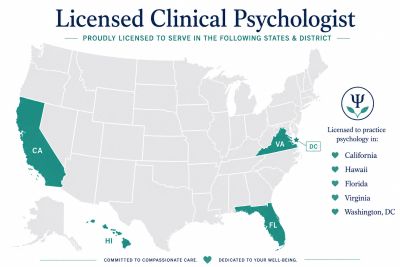
Online Acceptance and Commitment Therapy (ACT) in California, Hawaii, Florida, Virginia, and Washing
If you are searching for an ACT therapist, Acceptance and Commitment Therapy near me, online ACT therapy, virtual ACT therapy, telehealth ACT therapist, or an ACT psychologist accepting Cigna, online therapy may provide a convenient and effective way to access evidence-based mental health treatment from the comfort and privacy of your home.
As a licensed clinical psychologist, I provide online Acceptance and Commitment Therapy (ACT) for adults throughout California, Hawaii, Florida, Virginia, and Washington, DC, My practice specializes in helping individuals navigate anxiety, depression, trauma, PTSD, stress, burnout, relationship challenges, grief, life transitions, and other emotional difficulties through secure telehealth services.
ACT is one of the most widely researched behavioral therapies available today and has been shown to be effective for a wide range of mental health concerns. Rather than focusing solely on symptom reduction, ACT helps individuals develop greater psychological flexibility, strengthen emotional resilience, clarify personal values, and build more meaningful and fulfilling lives.
ACT Therapy Covered by Cigna/Evernorth Insurance
Many individuals searching for:
- ACT therapist accepting Cigna
- ACT therapist accepting Evernorth
- Cigna psychologist
- Cigna therapist
- Cigna ACT therapist
- Evernorth mental health provider
- Online therapy with Cigna
- Telehealth therapy covered by Cigna
- Cigna psychologist California
- Cigna psychologist Virginia
- Cigna therapist Florida
- Evernorth therapist Hawaii
- Cigna therapist Washington DC
are looking for a therapist who combines specialized expertise with insurance accessibility.
I am currently in-network with Cigna/Evernorth, allowing many clients to access high-quality psychotherapy using their mental health benefits. Coverage and out-of-pocket costs vary by plan, so I encourage clients to verify their specific benefits directly with Cigna/Evernorth.
For individuals with insurance plans that I do not accept, I can provide monthly superbills that may be submitted for possible out-of-network reimbursement depending on your policy.
Conditions Commonly Treated with ACT
Acceptance and Commitment Therapy can be particularly effective for individuals experiencing:
- Anxiety disorders
- Generalized anxiety
- Social anxiety
- Panic attacks
- Depression
- Trauma and PTSD
- Complex PTSD
- Chronic stress
- Burnout
- Grief and loss
- Relationship difficulties
- Perfectionism
- Self-criticism
- Low self-esteem
- Life transitions
- Emotional avoidance
- Men's mental health concerns
ACT helps clients develop practical skills for responding to difficult thoughts and emotions while remaining connected to what matters most in their lives.
Online ACT Therapy in California
As a licensed psychologist in California, I provide online ACT therapy throughout California, including Los Angeles, San Diego, Orange County, San Francisco, Sacramento, San Jose, Riverside, Fresno, Oakland, and surrounding communities.Individuals searching for ACT therapist California, online ACT therapy California, Acceptance and Commitment Therapy California, or Cigna therapist California can access treatment through secure telehealth sessions without the need to travel to an office.
Online ACT Therapy in Hawaii
I also provide online ACT therapy in Hawaii, serving clients throughout Oahu, Maui, Kauai, and the Big Island.Whether you are searching for an ACT therapist Hawaii, online therapy Hawaii, Cigna therapist Hawaii, or Acceptance and Commitment Therapy Hawaii, telehealth allows individuals across the islands to access specialized mental health care from their home or workplace.
Online ACT Therapy in Hawaii
I also provide online ACT therapy in Hawaii,, serving clients throughout Oahu, Maui, Kauai, and the Big Island.Whether you are searching for an ACT therapist Hawaii, online therapy Hawaii, Cigna therapist Hawaii, or Acceptance and Commitment Therapy Hawaii, telehealth allows individuals across the islands to access specialized mental health care from their home or workplace.
Online ACT Therapy in Florida
For adults living in Virginia,, I provide virtual ACT therapy throughout the state, including Miami, Fort Lauderdale, West Palm Beach, Orlando, Tampa, St. Petersburg, Jacksonville, Naples, Sarasota, and surrounding areas.Individuals searching for ACT therapist Florida, Acceptance and Commitment Therapy Florida, online therapist Florida, or Cigna therapist Florida may benefit from secure telehealth services designed to support long-term emotional well-being and personal growth.
Online ACT Therapy in Virginia
I provide online ACT therapy throughout Virginia, including Northern Virginia, Arlington, Alexandria, Fairfax, Richmond, Virginia Beach, Norfolk, Chesapeake, Charlottesville, Roanoke, and surrounding communities.Individuals seeking an ACT therapist Virginia, online ACT therapy Virginia, Acceptance and Commitment Therapy Virginia, or a Cigna psychologist Virginia can access evidence-based care through secure video sessions.
Online ACT Therapy in Washington DC
For adults living in the District of Columbia, I offer online ACT therapy in Washington DC for anxiety, depression, trauma, stress, burnout, grief, and relationship concerns.Whether you are searching for an ACT therapist Washington DC, Acceptance and Commitment Therapy DC, online therapy Washington DC, or a Cigna therapist DC, telehealth provides a flexible and accessible option for receiving specialized psychological services.
Begin Your Journey Toward Psychological Flexibility
Acceptance and Commitment Therapy is not about eliminating difficult thoughts and emotions. Instead, it helps individuals develop the flexibility to respond to life's challenges with greater openness, self-compassion, resilience, and purpose.If you are looking for an ACT therapist accepting Cigna/Evernorth, online ACT therapy, virtual therapy for anxiety, telehealth trauma therapy, or Acceptance and Commitment Therapy in California, Hawaii, Florida, Virginia, or Washington DC, I would be happy to discuss whether my services may be a good fit for your needs.
ACT and Trauma: Building a Meaningful Life Beyond Trauma

Acceptance and Commitment Therapy for Trauma, PTSD, and Complex PTSD
Trauma can profoundly impact the way we think, feel, relate to others, and experience ourselves. Whether the trauma stems from a single overwhelming event or from repeated experiences such as childhood neglect, abuse, attachment wounds, bullying, discrimination, medical trauma, or relationship betrayal, its effects can linger long after the original danger has passed.
Many trauma survivors struggle with:
- Intrusive memories
- Hypervigilance
- Anxiety and panic
- Emotional numbness
- Shame and self-criticism
- Avoidance of reminders
- Difficulty trusting others
- Relationship challenges
- Feelings of disconnection
- Low self-esteem
- Chronic stress and burnout
Acceptance and Commitment Therapy (ACT) offers a compassionate, evidence-based approach to trauma recovery that focuses not only on reducing suffering but also on helping individuals reconnect with what matters most in their lives.
How Trauma Affects Psychological Flexibility
One of the central ideas of ACT is that psychological suffering often increases when individuals become trapped in patterns of avoidance, emotional struggle, and attempts to control internal experiences.
For trauma survivors, these strategies are often understandable and adaptive responses to overwhelming events.
You may find yourself:
- Avoiding certain places, people, or situations
- Suppressing painful emotions
- Constantly scanning for danger
- Becoming disconnected from your body
- Criticizing yourself for what happened
- Organizing your life around preventing future pain
While these strategies may initially provide a sense of safety, they can gradually limit freedom, connection, and personal growth.
ACT helps individuals develop psychological flexibility—the ability to remain present, open, and engaged in life even when difficult thoughts, emotions, and memories arise.
The goal is not to forget what happened.
The goal is to help trauma stop determining what is possible for your future.
ACT Is Not About Accepting Trauma
One of the most common misconceptions about Acceptance and Commitment Therapy is that acceptance means approving of, liking, or accepting traumatic experiences.
This is not what ACT teaches.
ACT does not ask individuals to accept abuse, violence, neglect, discrimination, or other harmful experiences.
Instead, ACT focuses on accepting the reality that painful memories, emotions, and bodily sensations may exist without allowing them to completely dictate how we live our lives.
Acceptance in ACT means:
- Making room for painful emotions
- Reducing the struggle against internal experiences
- Letting go of the fight with thoughts and memories
- Redirecting energy toward healing and meaningful living
Acceptance is not surrender.
It is creating space for healing.
ACT and PTSD
Many individuals living with PTSD become trapped in cycles of avoidance.
Avoidance may involve:
- Avoiding conversations about trauma
- Avoiding places associated with memories
- Avoiding emotions
- Avoiding intimacy and relationships
- Avoiding vulnerability
- Avoiding uncertainty
While avoidance can reduce distress in the short term, it often reinforces PTSD symptoms over time.
ACT helps trauma survivors gradually build the willingness to experience difficult emotions and memories while reconnecting with life.
Research suggests that Acceptance and Commitment Therapy can help reduce:
- PTSD symptoms
- Emotional avoidance
- Shame
- Anxiety
- Depression
- Functional impairment
while improving:
- Quality of life
- Emotional resilience
- Psychological flexibility
- Values-based living
ACT for Complex PTSD and Developmental Trauma
Many individuals seeking therapy are not struggling with a single traumatic event but rather with the cumulative effects of chronic childhood experiences.
Complex trauma may involve:
- Emotional neglect
- Childhood abuse
- Attachment injuries
- Chronic criticism
- Emotional invalidation
- Family dysfunction
- Relational trauma
These experiences can shape how individuals view themselves, others, and the world.
Common beliefs may include:
- "I am not good enough."
- "I am broken."
- "I cannot trust anyone."
- "I am unlovable."
- "Something is wrong with me."
ACT helps individuals develop a different relationship with these painful stories through a process called cognitive defusion.
Rather than treating these beliefs as objective truths, individuals learn to recognize them as learned experiences that do not have to define their future.
ACT and Shame
Shame is often one of the most painful consequences of trauma.
Many trauma survivors carry profound feelings of:
- Defectiveness
- Unworthiness
- Self-blame
- Self-criticism
ACT helps individuals respond to shame differently.
Rather than attempting to eliminate shame, ACT encourages:
- Self-compassion
- Acceptance
- Perspective-taking
- Values-based action
Over time, individuals often learn that they can experience shame without allowing it to dictate their identity.
Reconnecting With What Matters Most
Perhaps the most powerful aspect of ACT is its emphasis on values.
Trauma often narrows life.
People may stop pursuing:
- Relationships
- Career goals
- Hobbies
- Personal growth
- Adventure
- Creativity
- Intimacy
The focus becomes survival.
ACT helps individuals gradually reconnect with what matters most.
Rather than asking:
"How do I stop feeling this way?"
ACT asks:
"What kind of life do I want to build, even if difficult emotions continue to arise?"
This shift often marks the beginning of profound healing.
Trauma Recovery Is About More Than Symptom Reduction
Healing from trauma involves more than simply reducing symptoms.
True recovery often includes:
- Reclaiming a sense of self
- Building meaningful relationships
- Developing self-compassion
- Living in alignment with personal values
- Finding purpose and meaning
- Reconnecting with hope
Acceptance and Commitment Therapy provides a powerful framework for this journey.
While ACT cannot erase painful experiences, it can help individuals develop the psychological flexibility needed to carry those experiences differently—creating more space for connection, growth, resilience, and a life that feels rich, meaningful, and worth living.
Related ACT Blogs

Why Work With Dr. Sven Schild for Acceptance and Commitment Therapy (ACT)?
Choosing a therapist is an important decision. While many mental health professionals incorporate elements of Acceptance and Commitment Therapy into their work, relatively few have pursued extensive specialized training with the leading developers, researchers, and trainers who helped shape ACT into one of today's most respected evidence-based therapies.
As a Licensed Clinical Psychologist with more than 20 years of clinical experience, I have spent the past decade deepening my expertise in Acceptance and Commitment Therapy through advanced training, consultation, and continuing education with many of the most influential voices in the ACT community.
My ACT training includes coursework with Dr. Steven C. Hayes, one of the founders of Acceptance and Commitment Therapy and the originator of the psychological flexibility model that underlies ACT. I have also completed advanced training with Dr. Kelly Wilson, a co-founder of ACT whose work has helped shape the field for decades, as well as Dr. Robyn Walser, a leading ACT trainer and author known for her work applying ACT to trauma, anxiety, anger, and emotional resilience. Additional training with Emily Sandoz, PhD, and Matthew Booney, LCSW, has further strengthened my understanding of ACT principles and their practical application in psychotherapy.
Beyond my ACT training, I bring a broad trauma-informed perspective to treatment as an EMDRIA-Certified EMDR Therapist, EMDRIA Approved Consultant, and Somatic Experiencing® Practitioner (SEP). This allows me to integrate ACT with other evidence-based approaches when clinically appropriate, helping clients address not only difficult thoughts and emotions, but also the impact of trauma, attachment wounds, nervous system dysregulation, and longstanding patterns of avoidance.
My approach to ACT is collaborative, experiential, and compassionate. Rather than focusing solely on symptom reduction, I help clients develop greater psychological flexibility, strengthen emotional resilience, clarify personal values, and build lives that feel meaningful and authentic. Whether you are struggling with anxiety, depression, trauma, stress, self-criticism, relationship challenges, or life transitions, ACT offers practical tools for navigating life's inevitable difficulties while moving toward what matters most.
If you are looking for an ACT therapist, Acceptance and Commitment Therapy psychologist, or online ACT therapy in California, Hawaii, Florida, Virginia, or Washington DC, I would be honored to support you on your journey toward greater flexibility, resilience, and well-being.
Frequently Asked Questions About Acceptance and Commitment T

1. What is Acceptance and Commitment Therapy (ACT)?
Acceptance and Commitment Therapy (ACT) is an evidence-based psychotherapy approach that helps individuals develop greater psychological flexibility. Rather than trying to eliminate difficult thoughts and emotions, ACT teaches people how to respond to them more effectively while taking meaningful actions aligned with their values.
2. How is ACT different from Cognitive Behavioral Therapy (CBT)?
While both ACT and CBT are evidence-based therapies, CBT often focuses on identifying and changing unhelpful thoughts, whereas ACT focuses on changing your relationship with thoughts. ACT teaches skills such as acceptance, mindfulness, cognitive defusion, and values-based action rather than challenging the content of thoughts directly.
3. Is Acceptance and Commitment Therapy evidence-based?
Yes. ACT is supported by hundreds of scientific studies and has been shown to be effective for a wide range of mental health concerns, including anxiety, depression, PTSD, chronic pain, OCD, stress, substance use disorders, and relationship difficulties.
4. What is psychological flexibility?
Psychological flexibility is the ability to remain present, open, and engaged in life even when experiencing difficult thoughts, emotions, or circumstances. It is considered the central goal of ACT and is associated with greater resilience, emotional well-being, and life satisfaction.
5. What are the six core processes of ACT?
The six core processes of Acceptance and Commitment Therapy are:
- Acceptance
- Cognitive Defusion
- Present Moment Awareness
- Self-as-Context
- Values
- Committed Action
Together, these processes help individuals develop psychological flexibility and build meaningful lives.
6. Does ACT help with anxiety?
Yes. ACT is widely used to treat anxiety disorders, including generalized anxiety, social anxiety, health anxiety, performance anxiety, and panic disorder. ACT helps individuals develop a healthier relationship with anxiety while reducing avoidance and increasing engagement in valued activities.
7. Can ACT help with depression?
Yes. ACT has been shown to be effective in treating depression by helping individuals reduce rumination, reconnect with personal values, increase meaningful activity, and develop greater self-compassion and psychological flexibility.
8. Does ACT help with trauma and PTSD?
ACT can be highly effective for trauma and PTSD, particularly when integrated with trauma-focused approaches such as EMDR therapy, Somatic Experiencing®, or Sensorimotor Psychotherapy. ACT helps individuals reduce avoidance, increase emotional tolerance, and build a meaningful life beyond trauma.
9. What are values in ACT?
Values are personally meaningful qualities that guide how you want to live your life. Examples include compassion, honesty, courage, connection, growth, and authenticity. Unlike goals, values are ongoing directions rather than destinations.
10. What happens during an ACT therapy session?
ACT sessions may include mindfulness exercises, discussions about values, exploration of difficult thoughts and emotions, cognitive defusion techniques, behavioral exercises, and the development of practical strategies for moving toward meaningful goals. Sessions are collaborative, experiential, and tailored to each individual's needs.
11. Does ACT work online?
Yes. Research has demonstrated that Acceptance and Commitment Therapy can be highly effective through telehealth and online therapy. Many ACT exercises, mindfulness practices, and values-based interventions translate well to secure video sessions.